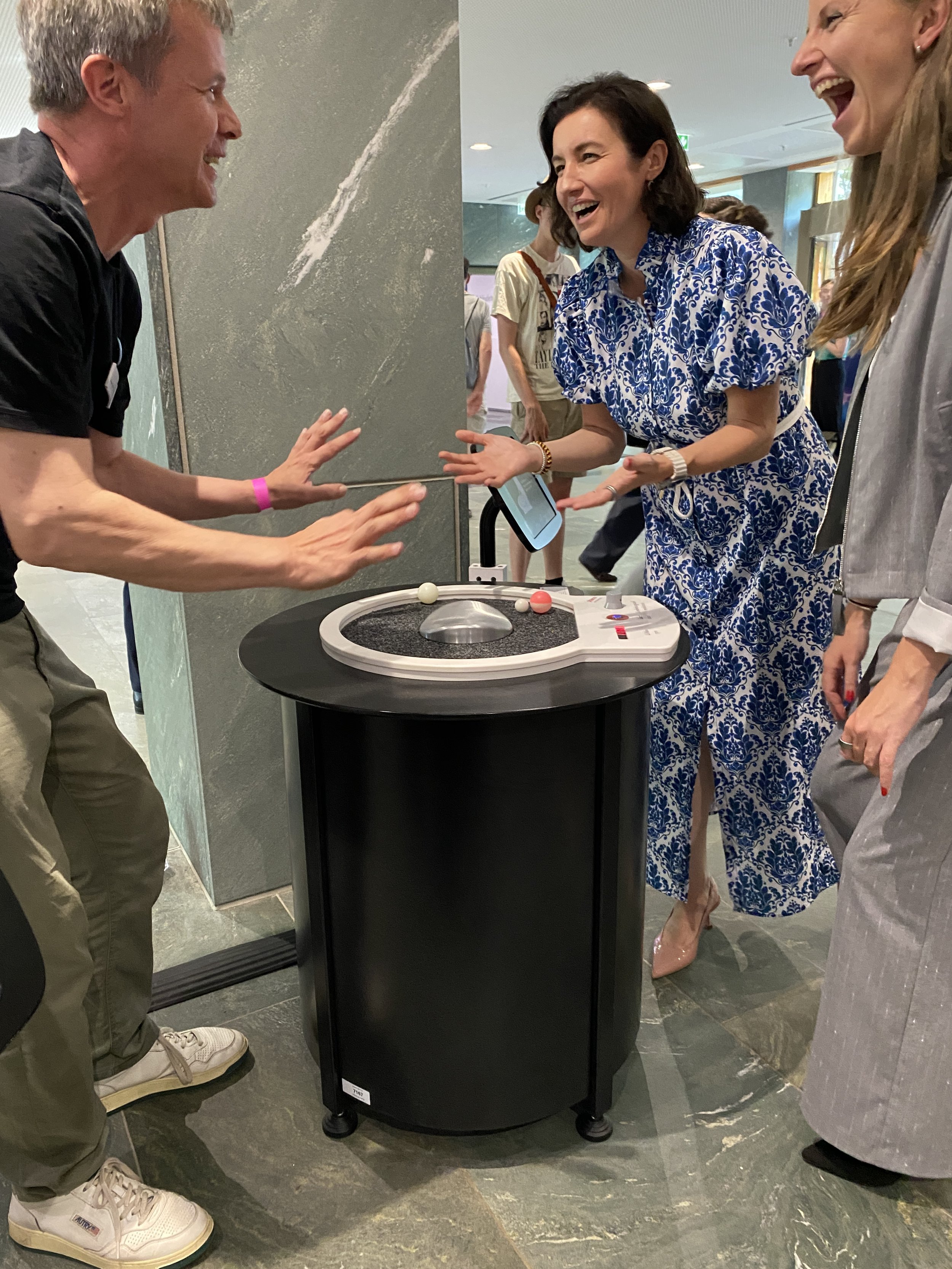
Minister Dorothee Bär visits QVLS-iLabs
Despite heat and rain: enormous interest in research and quantum technology at the Federal Government's Open Door Day.
Last weekend, #clusters4future QVLS-iLabs was represented at the BMFTR in Berlin, bringing two hands-on ion trap exhibits from phaeno gGmbH to the heart of the capital. Both demonstrators showed visitors one of the most fascinating things you can do in a physics lab: trap electrically charged particles and hold them in place using nothing but electric fields. The exhibits drew a steady stream of curious visitors across both days, with questions ranging from the very basic to the surprisingly technical.
A true highlight was the visit of Dorothee Bär, our Federal Minister of Research, Technology and Space of Germany, who stopped by our stand and took a genuine interest in how ion traps work and what they mean for the future of quantum computing. Seeing a minister engage directly with the science and our work was a moment that captures exactly what this kind of event is for.
On Saturday, Larissa Braun took to the stage with her talk "How do you trap atoms and how do you compute with them?", one of the most fundamental questions in quantum computing made accessible to a general audience. From the basic principles of ion trapping to their application in quantum computers, she also introduced the QVLS ecosystem, bringing the technology and the community behind it to life for visitors of all ages and backgrounds.
As part of the BMFTR's Challenge Accepted rally, our stand became a place of genuine hands-on discovery. Visitors made particles levitate, caught balls in a rotating saddle and earned a stamp for their efforts along the way. The questions kept coming: How exactly do you trap charged particles? What are ion traps actually used for? Why does this matter for computing? Every single one of them a good sign.
Two days, one clear message: the interest in quantum technologies and their real-world applications is enormous. Young and old, experts and first-timers, everyone wanted to understand. #clusters4future QVLS-iLabs is proud to be part of that conversation, and to share the excitement of what is being built in Lower Saxony with the world beyond the lab.