
Kai Voges establishes new research group on hybrid quantum systems
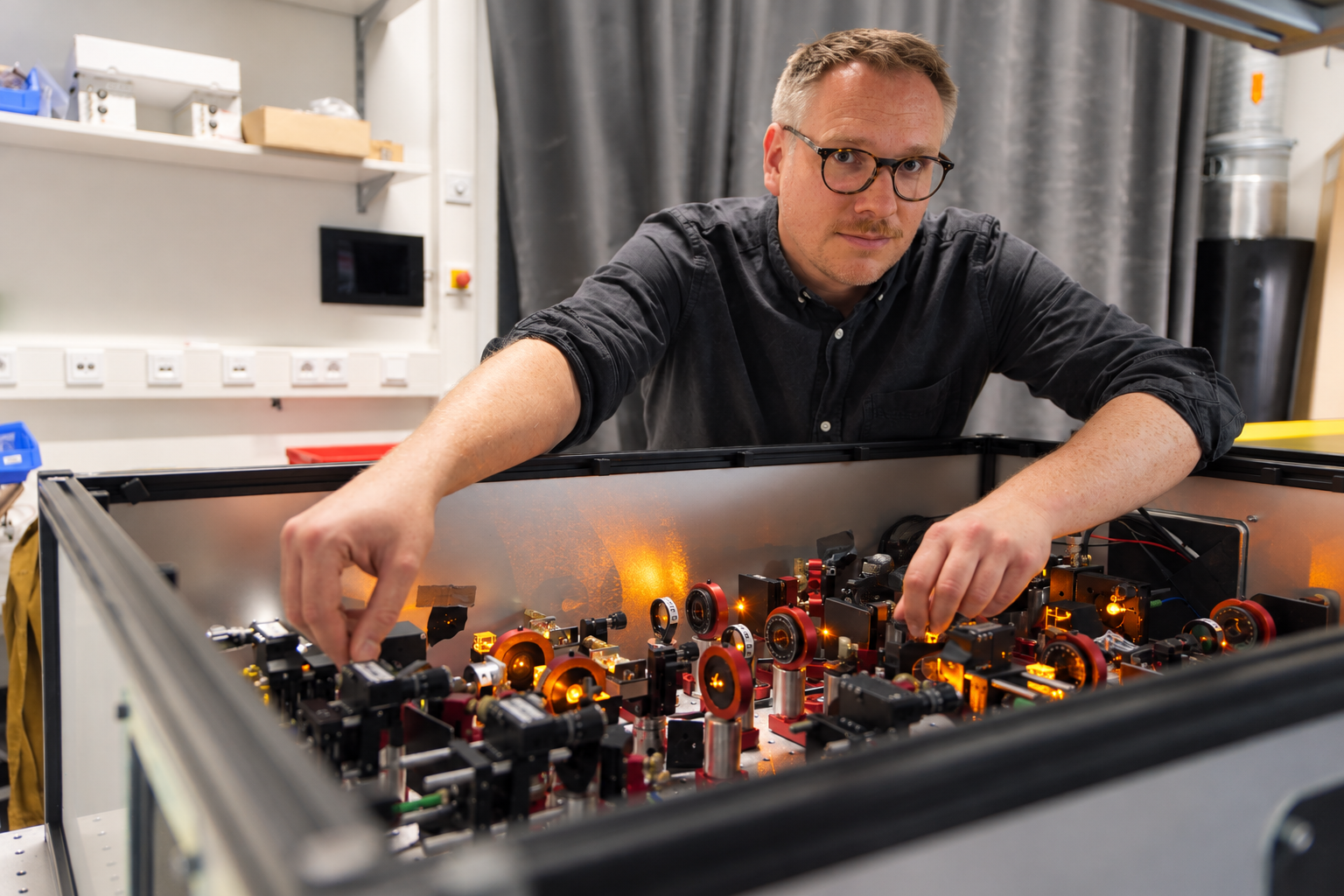
When the scientific community discusses quantum computers, it is usually the question of the underlying system that causes division. Ion traps, Rydberg atoms, or perhaps superconducting circuits? At Leibniz University Hannover, Dr Kai Voges has launched a new research group that positions itself between these factions and aims to combine the strengths of these different approaches without reservation. Located at the heart of Quantum Valley Lower Saxony (QVLS) and building on the fundamental research of the QuantumFrontiers Cluster of Excellence, the research group is developing hybrid quantum systems. With 5.8 million Euros in funding from the Federal Ministry of Research, Technology and Space, the aim is to achieve the first gate operations of a unique technology within five years and to steer the current debate on quantum computing in new directions.
Molecules meet atoms
At the heart of the idea are ultra-cold molecules and individual atoms. Kai Voges has acquired the expertise required for this throughout his scientific career to date. As a PhD student at the Institute for Quantum Optics in Hanover – historically the leading centre for molecular physics – he assembled molecules from individual cooled atoms. He subsequently expanded his area of expertise at Imperial College London, where he cooled entire molecules down to just a few degrees Kelvin. As head of his own research group, molecules remain the focus of Voges’s work: they are intended to become the qubits of a quantum computer in the future. However, he is bringing not only new experience but also a new, additional system to his alma mater: Rydberg atoms.
Kai Voges: “My aim is to be able to make complementary use of the respective strengths of molecules and Rydberg atoms. As qubits, molecules have long coherence times, which means they can store quantum information for seconds or even minutes. A quantum computer made up of molecules would therefore, based on the current state of the art, be good at storing information but slow at computing, as molecules interact very little with one another. Rydberg atoms, on the other hand, are extremely fast and flexible when it comes to transmitting information, but are currently too unstable to serve as the sole hardware for quantum computers. We therefore aim to combine the stability of molecules with the speed of Rydberg atoms.”
Technological objective: Gate operation; scientific applications: Countless
With funding from the Federal Research Ministry's Quantum Futur programme, Kai Voges is setting up a research group with the aim of realising the first quantum computer gate operations using molecules and Rydberg atoms. Depending on the level of technological maturity, the researchers are also considering setting up a spin-off. In addition to implementing their own concept, however, collaborations with other groups within Quantum Valley Lower Saxony and the QuantumFrontiers Cluster of Excellence are also on the agenda. As a new system, Rydberg atoms thus not only broaden the scope of the Institute of Quantum Optics but also create new synergies.
Kai Voges: “I am particularly looking forward to establishing new collaborations, especially in relation to the theory of the new quantum gates. It will be just as exciting to build bridges with the strong-ion trap groups at Leibniz University and the Physikalisch-Technische Bundesanstalt. This goes beyond the construction of quantum computers. One could also envisage a dual clock in which molecules and individual atoms contribute their respective strengths. Simply by utilising the different clock transitions of the systems, respective sources of noise could be cancelled out, thereby producing a low-noise signal.”
Project Overview
The project ‘Hybrid Systems for Quantum Computing and Simulation (HybriQCS)’, led by Kai Voges, was successful in the third round of the Quantum Futur competition for early-career researchers organised by the Federal Ministry of Research, Technology and Space. The application-oriented funding, totalling 5.8 million euros, began on 1 March 2026 and will run for five years until 28 February 2031.
Photo Credit: Fritz v. Gierke